The Real Center of Pelican Landing Isn't the Golf Course
September 3, 2026
September 3, 2026
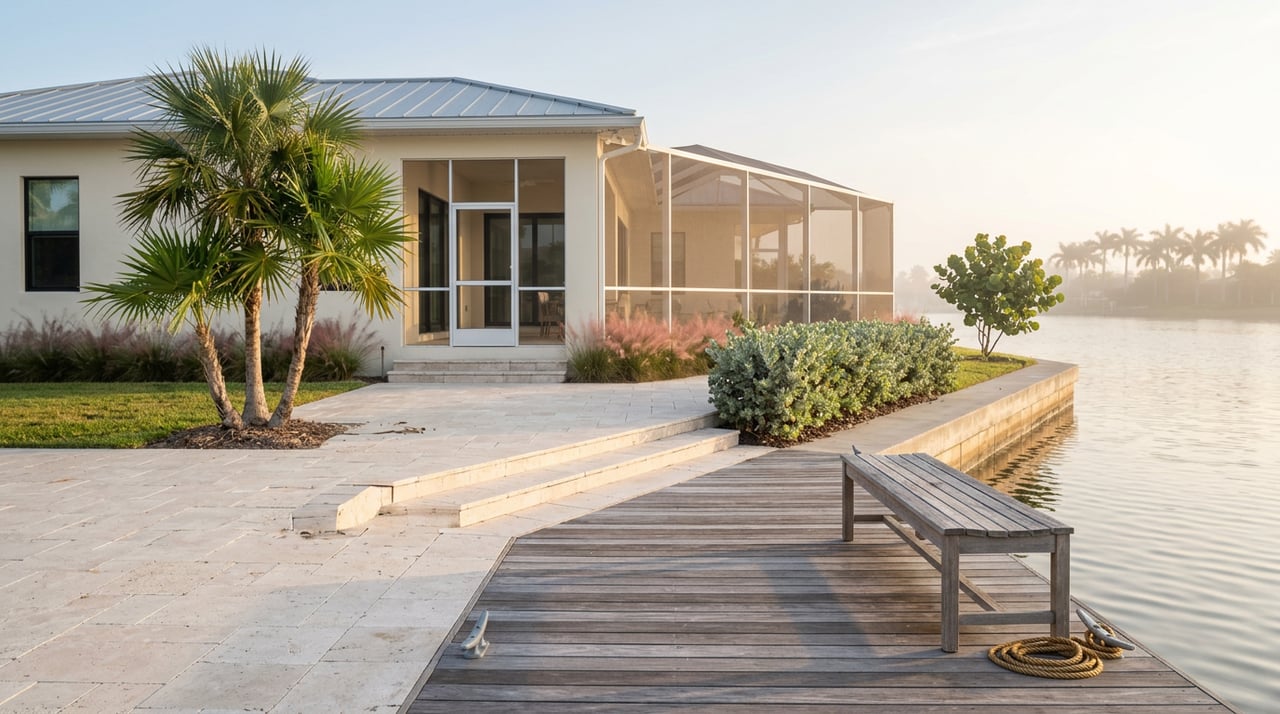
Thursday afternoon at Pelican Landing looks nothing like the brochure. Nobody is teeing off at the same hour. A handful of residents are already down at the marina waiting on the shuttle boat, watches checked, coolers packed, because the ride to Big Hickory Island runs on a schedule, not a whim. Someone else is walking off the tennis courts as the lights come on for night play. A few more are settling into the veranda at The Nest before the sun drops behind Spring Creek. None of this happens in one building, on one clock, or under one roof.
That's the part the marketing photos never capture. Pelican Landing isn't organized around a single clubhouse the way a lot of newer Bonita Springs communities are. It's organized around four separate outposts, built over four different decades, and the thing that actually structures a resident's week isn't a tee time. It's a boat schedule.
The 34-acre Beach Park on Big Hickory Island is the amenity most people mention first, and for good reason. There's no bridge, no causeway, no drive-up parking lot. The only way in is the community's own shuttle boat, which makes the crossing across Estero Bay in about 12 minutes. That single fact changes the rhythm of a beach day here more than any other detail. You don't decide to go to the beach the way you decide to go to a restaurant. You check a departure time.
Once you're there, the island has more infrastructure than the word "beach park" suggests. There's an elevated beach house with open decks, two open-air picnic pavilions, a larger screened pavilion with its own deck, a pair of bocce courts, and a nature library. In 2017, the community and its neighboring partners at the Hyatt Regency Coconut Point completed a $2.8 million renourishment and stabilization project that widened the Gulf-facing shoreline by as much as 250 feet and added concrete groins to slow future erosion. That's not a rounding-error repair. It's the kind of capital commitment that tells you the association treats the island as permanent infrastructure, not a seasonal perk.
What that means in practice: access to the beach here is gated by logistics, not by weather or by season. If you live inside the gates, your beach days are planned around the shuttle, and that's a genuinely different daily habit than driving to a public access point whenever the mood strikes.
Golf built this community. Pelican's Nest Golf Club opened its first 18 holes in 1985 to serve guests of the original Ritz-Carlton Naples, and the two Tom Fazio-designed courses, Gator and Hurricane, are still the anchor most people picture when they think of Pelican Landing. But the most telling recent decision here wasn't about the golf at all.
In 2020, The Nest completed a $9 million clubhouse renovation, its first significant overhaul since the building opened two decades earlier. The centerpiece wasn't a new hole or a redesigned green. It was an expanded, elevated outdoor dining veranda looking west toward the golf course, Spring Creek, and Estero Bay. The club's own board president explained the reasoning plainly: member surveys showed people wanted more casual outdoor dining so they could stay on property for an evening out rather than traveling to other popular dining areas.
That's a small admission with a bigger implication. A club that already had two championship golf courses, a 50,000 square foot clubhouse, and decades of prestige still had to spend eight figures because members were driving off-property for dinner. The fix wasn't more golf. It was a better veranda.
If you play tennis or pickleball at Pelican Landing, you already know the courts don't share an address. The Tennis Center has 12 Har-Tru clay courts, seven of them lit for night play, with a dedicated pro running leagues, clinics, and tournaments. Pickleball lives at its own facility, the Pickleball Center at 24501 Walden Center Drive, a separate six-court complex built later and located apart from the tennis courts entirely.
That separation isn't unusual for Bonita Springs. A 2026 guide to the area's pickleball scene notes that communities like Pelican Landing, The Brooks, Bonita Bay, Vasari, and Palmira all built dedicated pickleball facilities as an addition to existing amenity packages rather than folding the sport into courts that already existed. The same guide singles out Pelican Landing as one of the largest and most active private pickleball programs in the city. The takeaway for anyone living here is practical rather than critical: your evening plans depend on which sport you're playing and which side of the community you're driving toward, because the two racquet sports were never designed to share a campus.
Ask a longtime resident what the community "feels like" day to day and golf rarely comes up first. What comes up is the calendar of themed social nights that run through the winter season. A recent seasonal schedule for the community included a BBQ buffet party, a Groovy 60's party with a live band, a fashion show luncheon, a Fat Tuesday celebration, an "On Safari" African adventure night, and a presentation on the Florida Wildlife Corridor. Add in the winter tradition of sunset and eco-tour cruises, guided beach walks, and beachfront concerts, and you get a picture of a community whose actual social center of gravity is programming, not the golf course leaderboard.
That list matters for a simple reason. Communities built primarily around a golf membership tend to advertise golf. Pelican Landing advertises the beach shuttle, the veranda, and a themed party circuit that has nothing to do with a scorecard. The capital spending backs that up. The money went into dining and shoreline, not into a third golf course.
None of this changes what the community is on paper: a large, established, amenity-heavy neighborhood with golf, tennis, pickleball, sailing, and a private beach. What it changes is how you plan a week inside it. If you're waiting on a beach day, check the shuttle schedule before you check the forecast. If you want dinner on property, the veranda at The Nest exists specifically because members asked for it after years of driving elsewhere. If pickleball is your sport, know that your court and your neighbor's tennis match are happening in two different parts of the community, not two ends of the same building.
Pelican Landing wasn't built in a single master plan moment. It grew in stages, from 1985 golf courses to a 2017 beach renourishment to a 2020 clubhouse renovation to a pickleball buildout that came later still. Living well here means understanding that the community is really four separate campuses stitched together by golf carts, shuttle boats, and four decades of incremental investment, not one integrated village.
That layered history is also what makes the neighborhood interesting to track from a real estate standpoint. Every one of those capital projects, the beach renourishment, the clubhouse expansion, the pickleball buildout, reflects a community association that keeps reinvesting rather than letting amenities age in place. For residents, that's the quiet reassurance behind the themed parties and the boat schedule: the infrastructure underneath the lifestyle keeps getting renewed.
If you're weighing a move within Pelican Landing, curious about how a specific enclave lines up with the amenities you actually use, or just want a straight read on how the community has evolved, GulfLifeHome is a good place to start that conversation. Discover your Gulf Coast lifestyle, and reach out to Kyle any time you want a local's read on the neighborhood you already call home.
I plan to bring my success to the local real estate industry to every client and beloved neighborhood. My expertise as a creative marketing liaison aligns traditional, digital, and social communications to offer strategic, creative counsel that meets client objectives while keeping them at the forefront of an authentic audience.
Get in Contact to Learn More